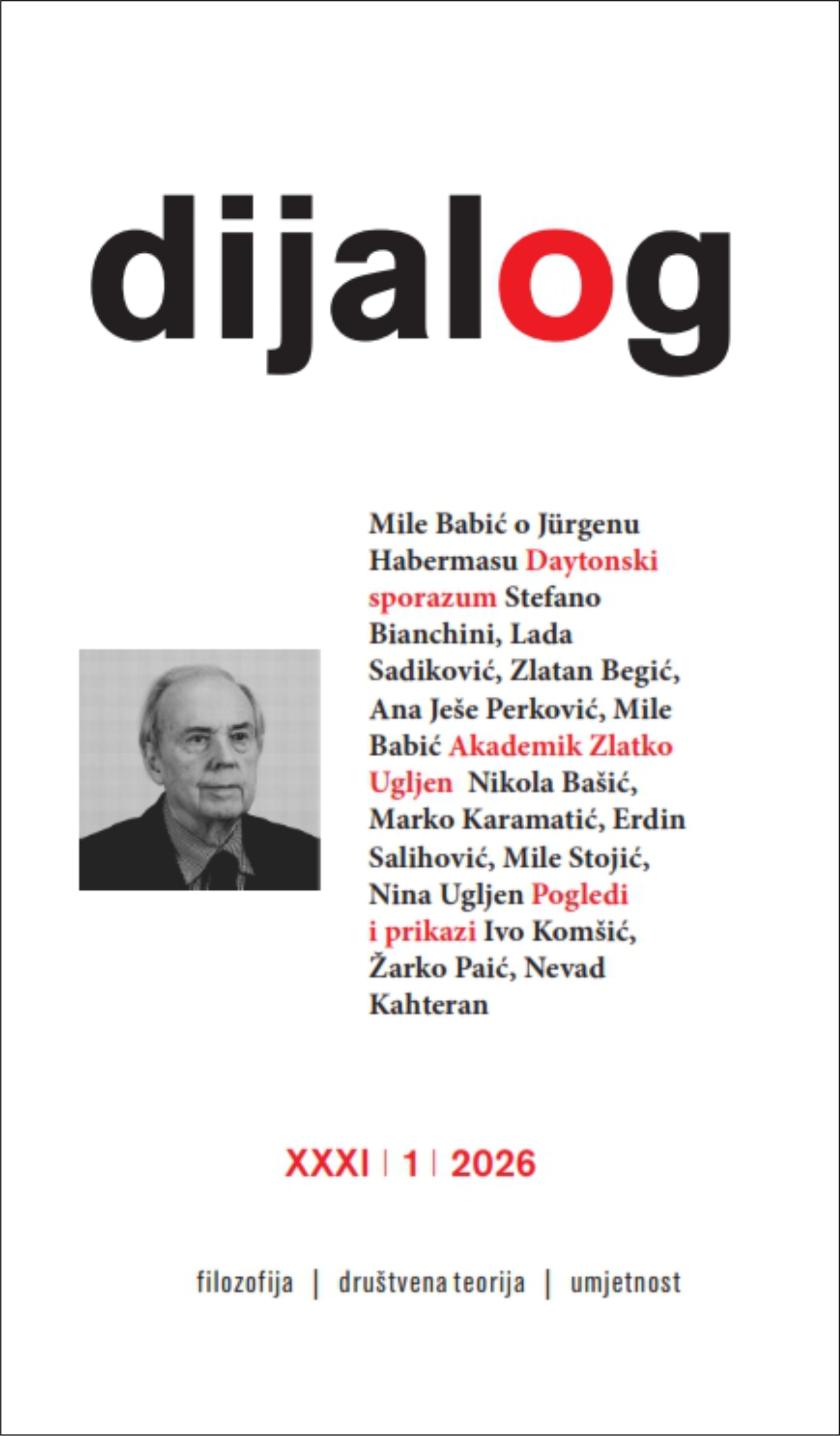
Granice EU uvjetovanosti: Demokratska reforma i retorička europeizacija u Bosni i Hercegovini
DOI:
https://doi.org/10.5644/DIJALOG.2026.1.05Keywords:
Bosna i Hercegovina, europske integracije, uvjetovanost EU, demokratizacija, Daytonski ustavni okvir, političke eliteAbstract
Spori i neujednačeni napredak Bosne i Hercegovine prema članstvu u Europskoj uniji naglašava ograničenja EU uvjetovanosti u postkonfliktnim i duboko podijeljenim društvima. Unatoč opsežnom angažmanu EU i usvajanju brojnih zakona i institucija inspiriranih EU, demokratska konsolidacija u Bosni i Hercegovini ostaje nepotpuna. Ovaj članak ispituje zašto je europeizacija koju provodi EU proizvela pretežno formalne, a ne suštinske demokratske promjene. Oslanjajući se na teoriju demokratizacije i model vanjskih poticaja europskih uvjeta, članak tvrdi da je učinkovitost europskih uvjeta u BiH ograničena padom kredibiliteta poticaja, rastućim troškovima usvajanja na domaćem nivou i strateškom upotrebom retoričkog djelovanja političkih elita. Analiza nadalje pokazuje kako ustavni okvir Bosne i Hercegovine, utemeljen na Daytonu, karakteriziran institucionalnom fragmentacijom i višestrukim točkama veta, olakšava opstrukciju reformi i slabi odgovornost.
References
Armakolas, Ioannis, Nikola Dimitrov, Isabelle Ioannides, Zoran Nechev, Oana Popescu-Zamfir and Valbona Zeneli (2024) “EU Enlargement to the Western Balkans: Where there is a will, there is a way”. IWM. https://www.iwm.at/sites/default/files/inline-files/EF_Europe-final.pdf (9. 2. 2026)
Bieber, Florian (2012) “Bosnia and Herzegovina since 1990”. In: Sabrina P. Ramet (ed.), Central and Southeast European Politics since 1989. Cambridge: Cambridge University Press, 311-327.
Dahl, Robert (1998) On democracy. New Haven in London: Yale University Press.
Dahl, Robert A. (1971) Polyarchy. Participation and Opposition. New Haven in London: Yale University Press.
Della Porta, Donatella (2003) Temelji politične znanosti. Ljubljana: Založba Sophia.
Direkcija za evropske integracije (2025) Istraživanje javnog mnijenja: Stavovi građana o članstvu u Evropskoj uniji i procesu integracija u EU. https://www.dei.gov.ba/bs/istrazivanja-javnog-mnijenja (5. 2. 2026)
Džananović, Nedžma (2025) Bosnia and Herzegovina and EU: European Path and Obstacles on the Way to Membership. BSF, Research Paper. Skopje: IDEFE Publications. https://balkanfoundation.com/wp-content/uploads/2025/05/BSF-Research-Paper-04.pdf (9. 2. 2026)
Džihić, Vedran and Angela Wieser (2011) “Incentives for democratisation? Effects of EU conditionality on democracy in Bosnia & Hercegovina”. Europe-Asia Studies 63(10), 1803-1825. https://doi.org/10.1080/09668136.2011.618681
Economist Intelligence Unit (2024) Democracy Index. https://www.eiu.com/n/campaigns/democracy-index-2024-confirmation/ (10. 2. 2026)
European Commission (2024) Bosnia and Herzegovina 2024 Report, SWD(2024) 691 final, Commission staff working document, Brussels, 30. 10. 2024. https://enlargement.ec.europa.eu/document/download/451db011-6779-40ea-b34b-a0eeda451746_en?filename=Bosnia%20and%20Herzegovina%20Report%202024.pdf (5. 2. 2026)
European Commission (2025) Bosnia and Herzegovina 2025 Report, SWD(2025) 751 final, Commission staff working document, Brussels, 4. 11. 2025. https://enlargement.ec.europa.eu/document/download/5d8fc547-f8f8-456f-84e3-b38998acfafd_en?filename=bosnia-and-herzegovina-report-2025.pdf (9. 2. 2026)
European Western Balkans (2025) “BiH cannot afford to lose more time waiting for the elections”. European Western Balkans, 22 September 2025. https://europeanwesternbalkans.com/2025/09/22/bih-cannot-afford-to-lose-more-time-waiting-for-the-elections/#:~:text=Addressing%20the%20media%20together%20with,the%20entity%20of%20Republika%20Srpska (9. 2. 2026)
Grabbe, Heather (2006) The EU’s Transformative Power. Basingstoke: Palgrave.
Ješe Perković, Ana (2014) “The European Union and the Democratization Process of the Western Balkans: A Critical Perspective”. Southeastern Europe 38(1), 112-133. https://doi.org/10.1163/18763332-03801005
Linz, Juan J. and Alfred Stepan (1996) Problems of Democratic Transition and Consolidation: Southern Europe, South America and Post-Communist Europe. Baltimore, London: The Johns Hopkins University Press.
Mason, David S. (1996) Revolution and Transition in East-Central Europe. Oxford: Westview Press.
Noutcheva, Gergana and Nathalie Tocci (2004) “Europeanization and Secessionist Conflicts: Concepts and Theories”. In: Bruno Coppieters et al. (eds), Europeanization and Conflict Resolution. Gent: Academia Press, 13-62.
Pejanović, Mirko and Zijad Šehić (eds.) (2016) Simpozij Daytonski mirovni sporazum i budućnost Bosne i Hercegovine, Sarajevo, 19. novembra/studenoga 2015. godine. Zbornik radova. Posebna izdanja CLXVI, Odjeljenje društvenih nauka 7, Odjeljenje humanističkih nauka 44. Sarajevo: Akademija nauka i umjetnosti Bosne i Hercegovine. https://bastina.anubih.ba/server/api/core/bitstreams/7a254db8-b2fb-480a-80e1-b99bfb6a5d5b/content (9. 2. 2026)
Pridham, Geoffrey (2005) Designing democracy. EU enlargement and regime change in post-communist Europe. Hampshire: Palgrave Macmillan.
Schimmelfennig, Frank (2003) The EU, NATO and the Integration of Europe: Rules and Rhetoric. Cambridge: Cambridge University Press.
Schimmelfennig, Frank and Ulrich Sedelmeier (2005) “Introduction: Conceptualizing the Europeanization of Central and Eastern Europe”. In: Frank Schimmelfennig and Ulrich Sedelmeier (ed.), The Europeanization of Central and Eastern Europe. Cornell: University Press, 1-28.
Schimmelfennig, Frank and Ulrich Sedelmeier (2020) “The Europeanization of Eastern Europe: the external incentives model revisited”. Journal of European Public Policy 27(6), 814-833. https://doi.org/10.1080/13501763.2019.1617333
Schimmelfennig, Frank, Stefan Engert and Heiko Knobel (2005) “The Impact of EU Political Conditionality”. In: Frank Schimmelfennig and Ulrich Sedelmeier (eds), The Europeanization of Central and Eastern Europe. Cornell: Cornell University Press, 29-50.
Vachudova, Milada Anna (2005) Europe Undivided: Democracy, Leverage, and Integration After Communism. Oxford: Oxford University Press.
Vachudova, Milada Anna (2014) “EU Leverage and National Interests in the Balkans: The Puzzles of Enlargement Ten Years On”. Journal of Common Market Studies 52(1), 122-138.
Vasilev, George (2011) “EU Conditionality and Ethnic Coexistence in the Balkans: Macedonia and Bosnia in a Comparative Perspective”. Ethnopolitics 10, 51-76.